


They Don't Make 'Em Like They Used To. Literally.
 JoeUser Forums
My old dryer ran for more than twenty plus years. I never did a thing to it. No belt, no bearings, no service call. It just dried clothes until we bought new a washer and dryer set.
That was about ten years ago. Three years in, the new dryer started to grind. The bearings in it were plastic/nylon (really?), and they had worn out. I took the thing apart and replaced them myself. A year later the belt went, and I replaced that too. Two repairs in four years on a machine whose predecessor needed zero in twenty.
And the dryer is the success story.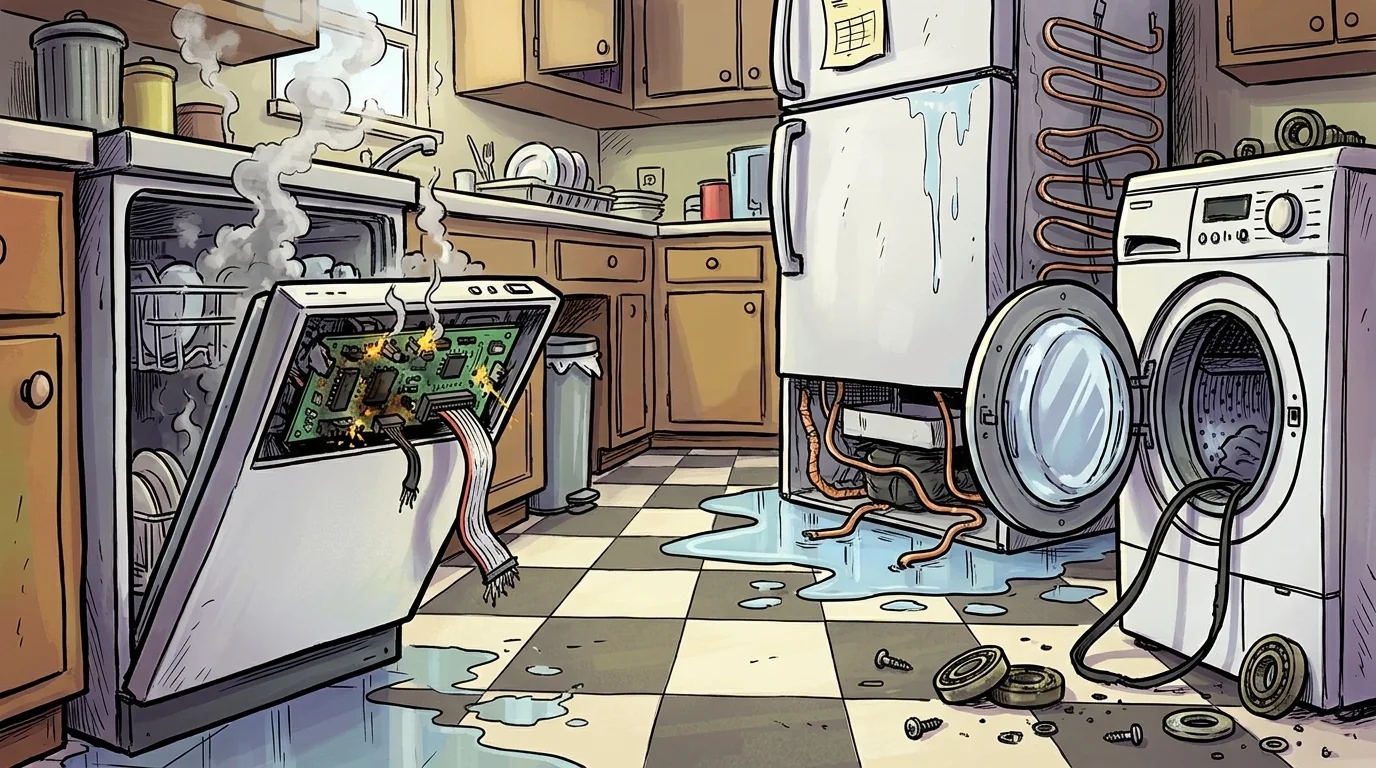
The dishwashers
I bought a Maytag. Two years later the control panel quit. The cause was a thin ribbon cable, the kind with etched traces instead of real wires, and one of the traces had burned through. Not a motor. Not a pump. A $3 cable.
Nobody sells the cable. The only fix is the whole control panel assembly, $150, half the price of the dishwasher. A slightly heavier cable would have carried the load fine and only cost pennies more. Somebody chose not to spend the pennies.
I repaired it twice, not very good, because it kept burning out. Then I gave up and bought another dishwasher, a GE this time.
Two years later the GE's buttons started ignoring me. Not every time, just often enough to make you stand there pressing Start like it owes you money. I lived with that for two more years, and finally got fed up with it and purchased a new unit.
The fridge
The Samsung refrigerator made it one year. One! The freezer stopped keeping things frozen, so I called a technician and he found a leak in the cooling line and tried to repair it. The copper tubing was so thin that it broke during the repair, beyond repair.
It was still under warranty, so I got my money back and bought a Frigidaire. It works, but, it also squeaks and makes noises I have never heard a refrigerator make. So sad.
My brother's house
My brother lives out in the country on well water with sulfur in it. He filters it. He runs it through purification. It doesn't matter. Enough sulfur still gets into the air that the electronics in his appliances corrode and quit, and nothing in his kitchen lasts more than a couple of years.
Note what fails: not the motors, not the drums, not the tubs. The circuit boards. The parts that didn't exist in the old machines.
It's not just appliances
Once you start noticing, it's everywhere. Printers that refuse to print because the ink isn't "genuine." Cars where changing a headlight bulb means pulling the front bumper.
Why?
I don't think it's one big conspiracy, though some of it is clearly on purpose. It's more a pile of small things. Bean counting! Where making money is priority one and quality is priority 100.
Cheaper parts. Adjusted for inflation, a dishwasher costs less today than it did decades ago. That money came from somewhere: thinner metal, plastic bearings, copper you can bend with a finger, and ribbon cables rated for a little less than the job.
More electronics. The old dryer had a dial, a motor and a heating element. The new machines have control boards, sensors, touch panels and displays. Every one of them is something else that can fail, and when it does, the board costs half the machine.
Nobody fixes anything anymore. Repair used to be normal. Every town had an appliance repair shop, and plenty of people could swap a belt themselves. That's mostly gone. Repair is a lost art. When something breaks now, the first thought isn't "what's wrong with it," it's "where's the cheapest new one." I fixed the dryer myself, both times, and I don't blame the people who wouldn't. When the part doesn't exist and the fix costs half a new unit, replacing it is the rational move. So the cycle continues.
Efficiency rules. Modern machines use a lot less water and power, which is genuinely good. But they work harder and longer to do it, and the parts wear sooner.
To be fair...
Not everything got worse. TVs are huge, inexpensive and gorgeous. Today's fridge uses a fraction of the electricity than they did 30 years ago. But "better on paper" and "lasts" aren't the same thing.